

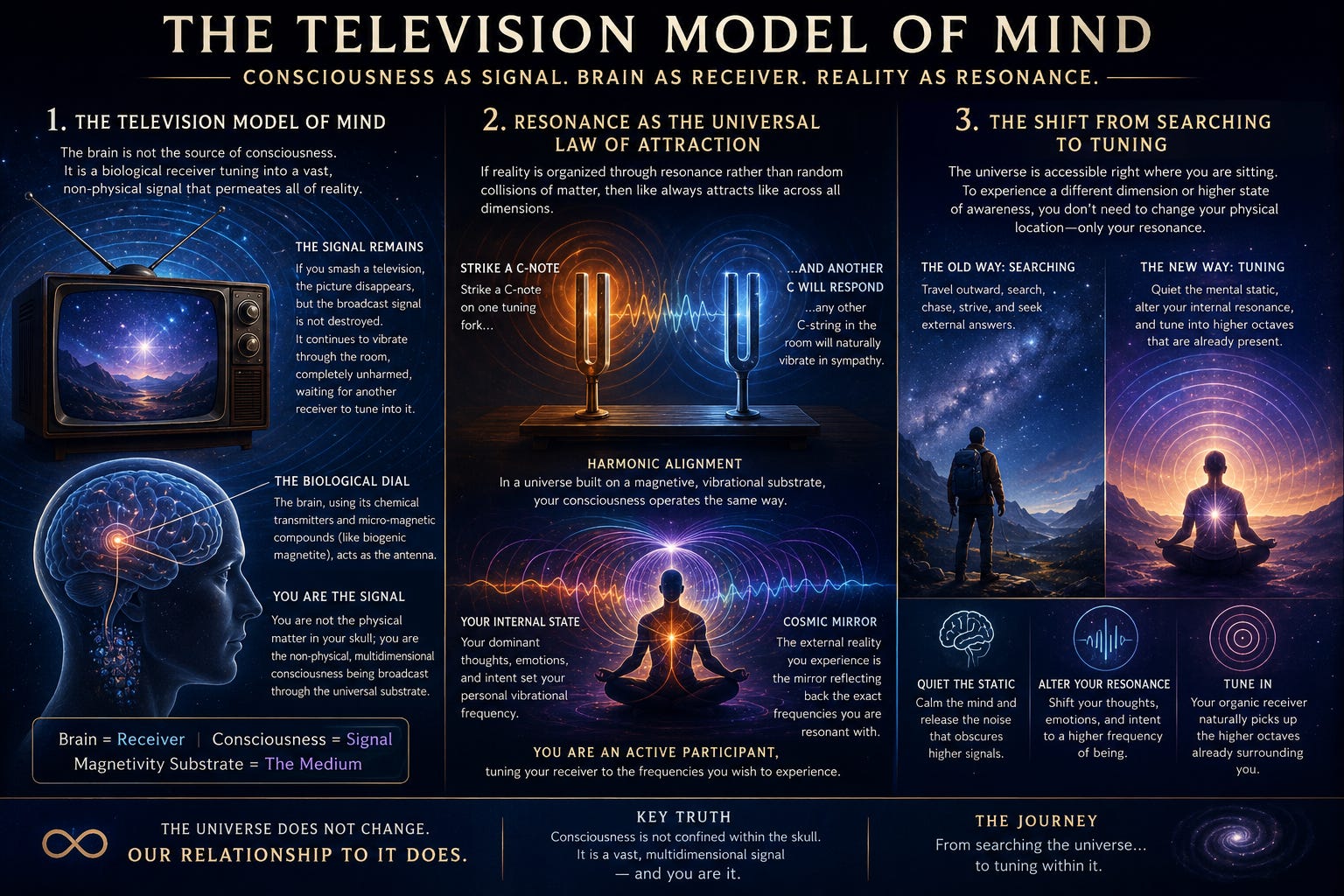
Mainstream neuroscience generally approaches the brain as a biological generator. Thoughts, emotions, memories, and awareness are understood to emerge from the extraordinarily complex interactions of billions of neurons communicating through electrochemical signals.
The Theory of Magnetivity explores a different possibility.
Rather than viewing the brain as a factory that manufactures consciousness, it proposes that the brain functions more like a highly sophisticated receiver within a universal harmonic field.
The Television Analogy
Imagine a television.
When the television is operating, a picture appears on the screen. If the television is destroyed, the picture disappears. Yet the broadcast itself has not ceased to exist. The electromagnetic signal continues to fill the room exactly as it did before. Only the receiver has been lost.
The Theory of Magnetivity proposes that consciousness may function in a similar way.
The biological brain becomes the receiver.
Consciousness becomes the signal.
The universal Magnetivity substrate becomes the medium through which that signal exists.
In this model, awareness is not manufactured by matter alone. Instead, the brain organizes, filters, and expresses a much broader field of consciousness into the localized experience we call human life.
This is a philosophical hypothesis rather than an established scientific conclusion, but it offers an alternative framework for exploring one of science’s greatest unanswered questions.
Resonance as the Organizing Principle
If reality is fundamentally organized through resonance rather than isolated interactions between separate objects, then resonance becomes the universal mechanism through which organization emerges.
Music provides an intuitive analogy.
Strike a C note on one piano, and another piano tuned to the same frequency can begin vibrating sympathetically. Nothing is physically transferred between them except energy carried through the surrounding medium.
The Theory of Magnetivity suggests that consciousness may operate through a similar principle.
Every thought, emotional state, and intention represents a pattern of organization within the universal substrate.
Rather than existing as isolated events, these patterns continually interact through resonance, coherence, and harmonic alignment.
Under this model, consciousness is not a passive observer moving through a random universe. It is an active participant whose internal state determines the patterns with which it most readily resonates.
From Searching to Tuning
This perspective fundamentally changes humanity’s search for understanding.
Traditionally, knowledge has been pursued by looking outward—building larger telescopes, more powerful microscopes, and increasingly sophisticated instruments.
Those tools remain essential for understanding the observable universe.
The Theory of Magnetivity proposes that another frontier exists alongside them.
If consciousness itself is part of the universal harmonic structure, then understanding reality also requires refining the receiver.
The challenge becomes less about traveling farther into space and more about tuning perception with greater precision.
In this framework, higher states of awareness are not separate places hidden somewhere beyond the stars. They are different modes of resonance within the same universal substrate.
Changing consciousness is therefore less like traveling to another location and more like tuning a radio to another station already present within the same space.
The universe does not necessarily become different.
Our relationship to it does.
A Universe of Harmonic Layers
If the Magnetivity substrate is fundamental, then dimensions may not be independent locations separated by impossible distances.
Instead, they may represent distinct harmonic modes existing simultaneously within the same universal medium.
Just as multiple radio broadcasts, Wi-Fi networks, and light frequencies occupy the same room without interfering with one another, multiple layers of reality could coexist within the same underlying substrate.
Human perception experiences only a narrow portion of that spectrum because the biological receiver is tuned to a specific range of resonance.
This concept remains speculative, but it offers a coherent philosophical framework for viewing consciousness, matter, and the structure of reality as expressions of a single underlying harmonic continuum.
Launching Soon:
Open Systems Television (OS.TV) is an open, vendor-neutral television platform designed to unify every form of television into a single user experience. Rather than being limited to one technology, OS.TV treats television as a collection of sources—including over-the-air (ATSC), cable-ready tuners, IPTV, HDHomeRun devices, Plex, Jellyfin, SAT>IP, TVHeadend, and future television technologies. Each source is normalized into a common data model, allowing channels, program guides, and playback to be managed consistently regardless of where the content originates. The platform’s architecture separates source discovery, channel preparation, program guide integration, and playback into independent components that can evolve without disrupting the overall system.
At its core, OS.TV introduces a universal television pipeline built around Detect → Prepare → Channels → Guide → Watch. Local hardware, such as USB television tuners, is connected through the OS.TV Local TV Connector, which securely communicates with the hosted OS.TV platform while keeping television signals private to the user’s own equipment. A capability-driven adapter framework enables each television source to expose only the functions it supports—such as scanning, importing, streaming, or guide synchronization—allowing new hardware and services to be added without changing the overall architecture. This modular approach makes OS.TV extensible while maintaining a simple, consumer-friendly interface.
Beyond being a television player, OS.TV is the foundation of a broader Open Systems Television Architecture (OSTA) that organizes and indexes streaming television on the Internet. Working alongside the WWBN logical broadcast numbering system, OS.TV provides a unified electronic program guide, channel management, discovery, and playback environment that spans both traditional broadcast television and Internet streaming platforms. The long-term vision is to create an open television ecosystem where broadcasters, content creators, hardware manufacturers, and viewers can participate without being locked into proprietary platforms, enabling a universal, searchable, and interoperable television experience.
A Universal Architecture for a Multidimensional Media Landscape
The upcoming launch of Open Systems Television (OS.TV) bridges the gap between this harmonic theory and everyday consumer technology. By treating infinite, disparate media streams as a single, normalized collection of sources, OS.TV mirrors the open, layered nature of reality itself. Through its core pipeline of Detect → Prepare → Channels → Guide → Watch, the platform strips away vendor lock-in and proprietary constraints, giving users absolute sovereignty over how they receive and organize information. Just as the mind refines its own perception to navigate different planes of awareness, OS.TV refines the biological and digital interface—allowing broadcasters, creators, and viewers to interact within a completely open, universal continuum. The future of television is no longer a collection of isolated boxes; it is a single, unified symphony of media.
Love this 5D New Human perception piece Alex, Is there a high resolution PDF link for it?