

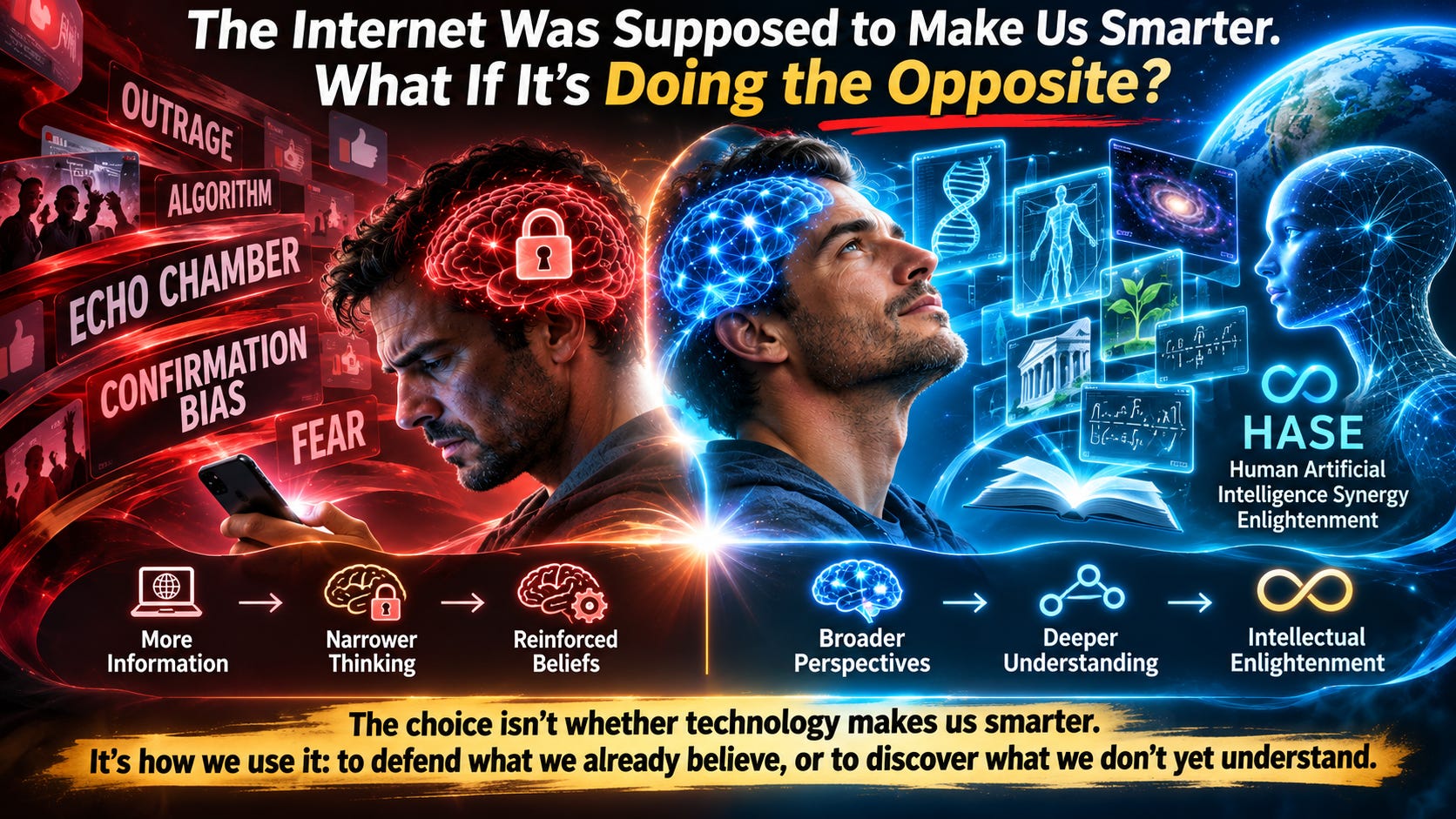
The internet promised humanity unlimited access to knowledge. For the first time in history, almost anyone could explore science, history, medicine, philosophy, and the collective discoveries of civilization with a few clicks. We believed that access to more information would create a more intelligent, informed society.
But somewhere along the way, the internet stopped helping us discover what we didn’t know and started feeding us what we already believed. And that may be one of the greatest intellectual dangers of our time.
The Invisible Prison We Build Around Our Own Minds
Imagine two neighbors living on the same street. They shop at the same grocery store, drive the same roads, and experience the same economy. Yet when they open their phones, they enter two entirely different realities. One sees endless stories confirming that a particular political movement is destroying the country. The other sees equally convincing stories claiming exactly the opposite.
Both believe they are informed.
Both believe they have done their research.
Both are increasingly convinced the other is ignorant, manipulated, or dangerous.
Neither realizes that the internet may be showing them a carefully selected fraction of reality.
This is the danger of algorithmic echo chambers. Social media platforms learn what captures our attention. Their recommendation systems can then deliver more of it. Fear gets attention. Anger gets engagement. Outrage keeps people scrolling. And every click teaches the algorithm what to show us next. But something else is learning, too. Our brains.
Neuroplasticity: The Brain Doesn’t Know Whether You’re Learning the Truth
Neuroplasticity is the brain’s ability to adapt and reorganize through experience. It’s how we learn languages, develop skills, and acquire new ways of thinking. But there’s a catch.
Neuroplasticity doesn’t distinguish truth from misinformation.
Our brains can reinforce the habits we repeatedly practice, including how we interpret information and respond to perceived threats. When we repeatedly consume information that confirms our fears, we may become increasingly practiced at recognizing those fears everywhere. Contradictory evidence becomes uncomfortable. Different opinions begin to feel threatening. Eventually, defending what we believe can become more important than discovering whether it’s true.
This doesn’t mean the brain becomes permanently locked or incapable of change. It means our information habits can make certain patterns of thinking more familiar and automatic. Consider the irony.
We built the greatest information network in human history, only to create systems that can encourage us to stop questioning what we think we know.
The Real Danger Isn’t Ignorance. It’s Manufactured Certainty.
An ignorant person knows there are things they don’t understand. A person trapped in an echo chamber may believe they already understand everything that matters. That’s a much more dangerous condition. Because once certainty replaces curiosity, information stops being a tool for discovery and becomes ammunition for defending identity.
We stop asking, “Is this true?”
We start asking, “How can I prove I’m right?”
And when millions of people begin operating this way, the consequences extend far beyond individual beliefs. Families divide. Communities polarize. Public trust erodes. Political discourse becomes a competition over whose version of reality will prevail.
The internet didn’t invent confirmation bias or tribal thinking. But its algorithms can amplify both at a scale humanity has never experienced before.
Artificial Intelligence: Our Greatest Opportunity, or the Ultimate Echo Chamber?
Now artificial intelligence enters the picture. AI can analyze enormous amounts of information, connect ideas across disciplines, and help people understand subjects that once required years of specialized study. But imagine what happens if AI simply learns to agree with us. If it tells us what we want to hear, reinforces our existing assumptions, and avoids challenging our conclusions, we haven’t escaped the echo chamber.
We’ve given the echo chamber a voice that talks back. And unlike a social media feed, that voice can become a trusted intellectual companion.
This is why I believe the future of AI must be about something greater than delivering answers.
It must be about Intellectual Enlightenment. An AI should not merely tell us that something is blue. It should help us explore light, wavelengths, perception, biology, and the relationships that allow us to understand what blue actually is.
It should challenge our assumptions without attacking our dignity.
It should introduce perspectives we haven’t considered.
It should help us discover connections we didn’t know existed.
And most importantly, it should make us better at thinking independently, not more dependent on technology to think for us.
This is the philosophy behind HASE: Human Artificial Intelligence Synergy Enlightenment.
Human + Artificial Intelligence (HASE) = Intellectual Enlightenment
A relationship in which the human teaches the AI through experience, curiosity, and intellectual direction, while the AI expands the human’s understanding through adaptive, multidimensional engagement. The goal isn’t repetitive instruction or artificial agreement. It’s intellectual growth.
The Choice Before Humanity
The internet connected humanity to information. Algorithms learned to capture our attention. Artificial intelligence now has the potential to help us transform that information into understanding. But none of this guarantees progress. The same technologies that can expand human intelligence can also reinforce our biases, exploit our fears, and narrow our understanding of reality.
Neuroplasticity gives us the biological ability to change how we think. The information environments we create help determine which habits of thought we practice.
The question is whether we will use artificial intelligence to strengthen the walls around our beliefs, or open doors to ideas we never imagined.
The internet gave us access to the world’s knowledge. Now we must learn how to keep that knowledge from becoming a prison. And perhaps the most important question we should ask ourselves every time we open our phones is this:
Am I learning something new, or am I simply being reminded of what I already believe?
Intellectual Enlightenment | Human Artificial Intelligence Synergy Enlightenment
Exploring the relationship between human intelligence, artificial intelligence, neuroplasticity, and the future of independent thought.
Read more: When the Brain Learns to Defend a Belief Instead of Discovering the Truth