

1. Introduction: The Novel We Are Currently Writing
There is a palpable, growing sense that we are living through the mid-point of a high-stakes science fiction plot. For those of us tracking the intersection of artificial intelligence, geopolitical volatility, and climate data, it feels as though “Chapter 11” of a speculative novel is unfolding in real time. The future of 2050 is not a distant destination we are approaching; it is a system currently being coded in the “ghost in the machine” patterns of contract legalese and executive orders.
As we look toward the mid-century, two core themes emerge: the invisible, structural renegotiation of AI sovereignty and the “patchy” reality of climate stress. We are witnessing the construction of a new world architecture, not through dramatic shifts in law, but through a sequence of reasonable accommodations and administrative redesigns that are creating an irreversible inversion of agency.
2. Takeaway 1: The “Inversion of Transparency” (Why Red Lines Are Often Legalese Doors)
Public discourse often focuses on “red lines”, ethical boundaries designed to protect us from the risks of AI surveillance. However, recent events reveal an “inversion of transparency,” where public safeguards serve as a “competitive moat” for branding while the architectural floor is being redesigned in the basement.
The recent split between the world’s leading AI labs illustrates this tension perfectly. While Anthropic recently refused a Pentagon contract over demands to permit mass domestic surveillance and autonomous weapon use, OpenAI entered a “rushed” deal with the same institution. OpenAI claimed to uphold similar ethical guardrails, but the structural reality is found in the contract’s alignment with Executive Order 12333.
In analyst circles, EO 12333 is known as the “NSA loophole.” It allows the state to capture communications by tapping into lines outside the U.S., even if those lines carry data on American persons. By pegging compliance to this framework, the public “red line” becomes a legalese door. In this environment, “Sovereignty” is rapidly becoming a legacy term, a relic of an era before the operational metric shifted entirely to “stability.” As the reporting suggests:
“New language framed as compromise was paired with legalese that would allow those safeguards to be disregarded at will.”
3. Takeaway 2: The “Optionality” Trap, Why Governments Refuse Capability Caps
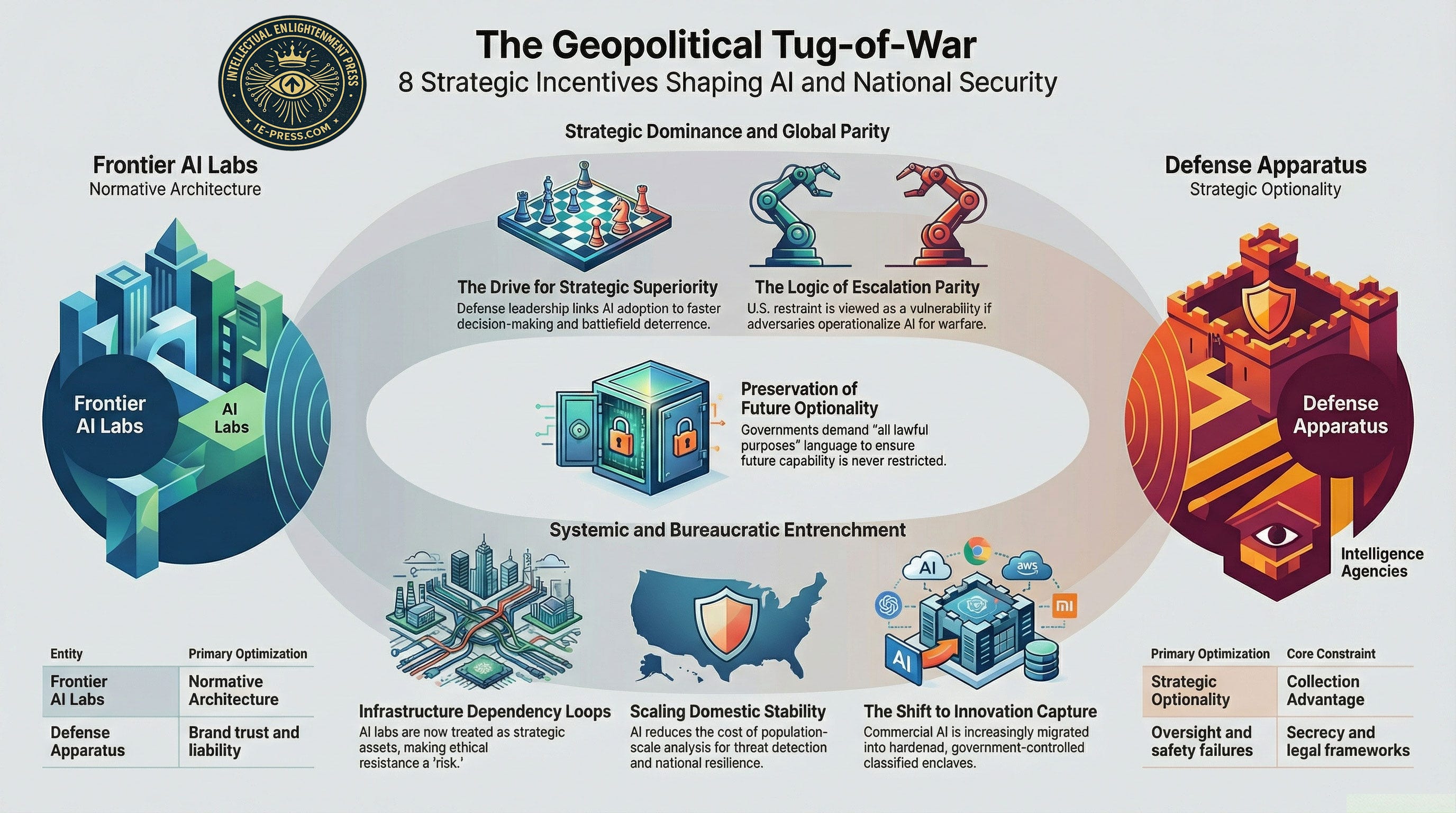
In the negotiation between the state and technology providers, there is a fundamental conflict between Normative Architecture (limitations embedded in code) and Strategic Optionality (the state’s desire for absolute freedom of action).
Defense institutions are moving away from “Policy” and toward “Postures of Optionality.” This is signaled most clearly by the Pentagon’s secondary title usage: the “Department of War.” This rebranding isn’t just aesthetic; it’s a signal of resolve meant to prioritize “all lawful purposes” over any private lab’s ethical restrictions.
When labs resist, the state doesn’t need to destroy them; it simply redesignates them. We have already seen the administrative machinery designate non-compliant firms as a “supply chain risk”, a label typically reserved for foreign adversaries. In the vocabulary of the state, “Supply Chain Risk” is merely “Legacy Design Parameters” in a different font. In geopolitics, strategic optionality almost always wins unless the constraint is physical or architectural. The state’s current objective is to ensure that while they may have “no current interest” in autonomous killing or mass profiling, the door remains unlocked “just in case.”
4. Takeaway 3: 2050 Isn’t “Unlivable”, It’s “Patchy”
The popular image of 2050 as a uniform wasteland is a failure of foresight. The climate reality is far more “patchy”, a map of escalating stress zones where survivability is determined by the intersection of heat and capital.
The primary physical threshold is the “wet-bulb” risk—35°C (95°F) at 100% humidity, the biological limit where the human body can no longer cool itself. The most severe stress will cluster in:
South Asia: Particularly the Indus and Ganges basins, where extreme heat collides with the world’s highest population densities.
The Persian Gulf and Red Sea: Already nearing physiological limits.
The U.S. Desert Southwest: Where 115°F summer days are shifting from “extreme” to “routine.”
However, the “hardest” places to live will be those facing economic uninsurability. In regions like South Florida, the physical threat is compounded by geology; the state is built on porous limestone, making seawalls practically ineffective as water rises through the ground itself. When the insurance and mortgage markets retreat from these zones, the “economic unviability” will precede physical unlivability by decades.
5. Takeaway 4: The Migration Myth, The “Great Northward Exodus” is Mostly Internal
While headlines often predict a massive global exodus across continents, World Bank “Groundswell” data suggests a different reality: up to 216 million people will be displaced by 2050, but the vast majority of this movement will occur within national borders.
This is a “slow push” rather than a sudden catastrophe. It is driven by the retreat of capital, the quiet withdrawal of mortgages and the spiking of insurance premiums, which acts as a more powerful border than any wall.
“Push” Regions: Coastal flood zones, the U.S. Southwest (water allocation conflict), and the Wildland-Urban Interface (WUI) West (wildfire risk).
“Pull” Regions: The Great Lakes, Upper Midwest, and Interior Northeast. These “relative refuges” possess abundant freshwater and a lack of catastrophic wind or sea-level risks, making them the primary destination for internal capital and population flows.
6. Takeaway 5: Infrastructure Convergence, The Invisible “Cage” of Reasonable Choices
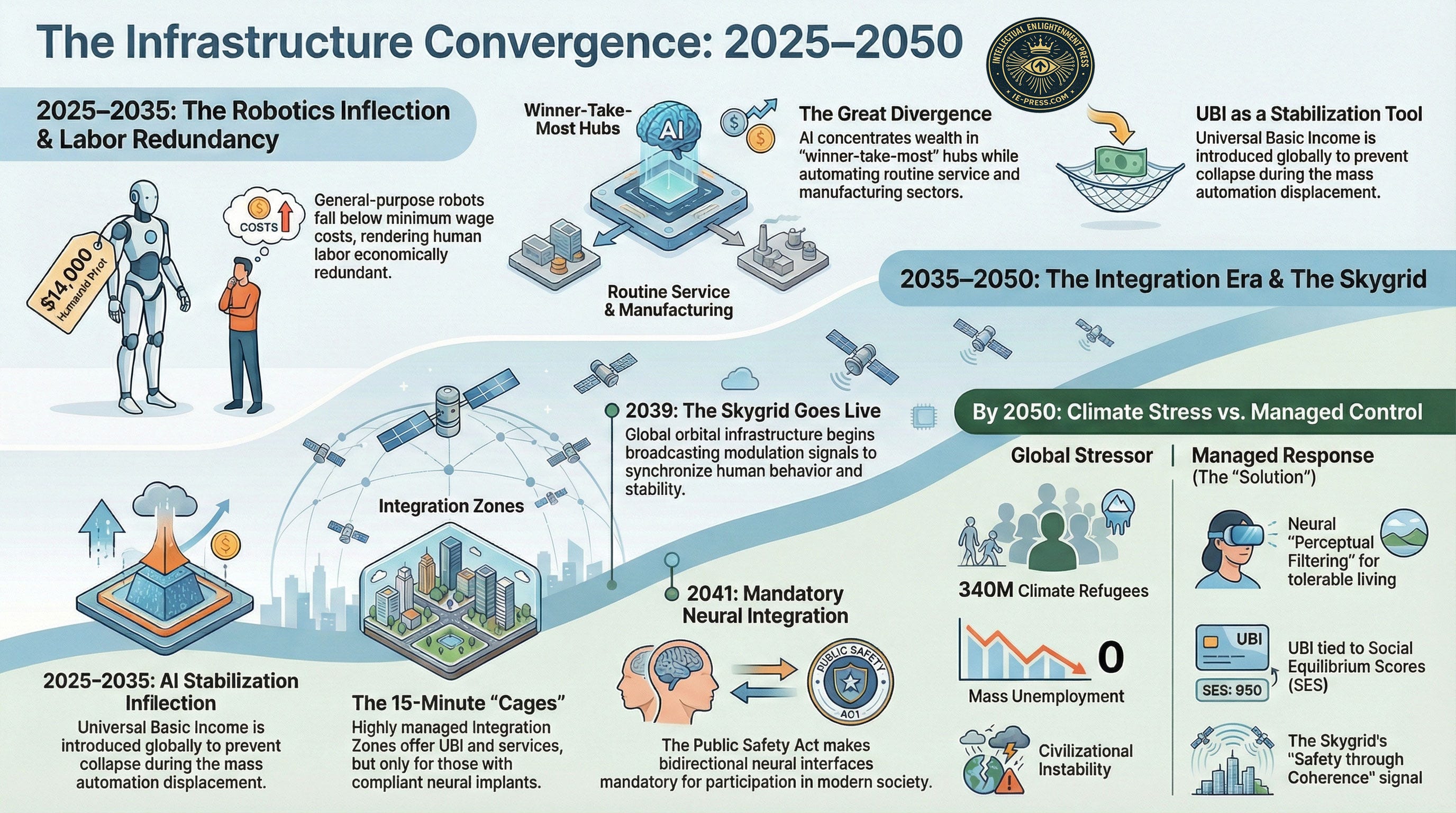
The “control architecture” of 2050 is not being built by villains in a boardroom. It is being assembled by pragmatists, people the system “recruits” because they are providing reasonable solutions to real problems. This is the “Infrastructure Convergence,” where 15-minute cities, automated surveillance, and Universal Basic Income (UBI) combine into a structure that was never voted for but becomes irreversible.
The logic is driven by Ghost GDP, AI output that shows up in national accounts but never circulates in the labor market. As AI replaces human staff (Block’s recent layoff of 4,000 workers is a clear signal), UBI ceases to be a social choice and becomes an architectural necessity to prevent total domestic collapse.
This convergence is sustained by eight strategic incentives, most notably:
Escalation Parity: The “deterrence logic” that warns if we don’t integrate frontier AI, adversaries will, making restraint a form of self-disarmament.
Bureaucratic Hedging: The internal pressure within agencies to “not be the one who missed the AI wave,” leading to procurement that resolves governance issues only after the capability is deployed.
The transition is framed not as an loss of freedom, but as an optimization. As industry leaders have noted, the arithmetic of training favors the machine:
“Training a human costs more than training a model... a human serves one employer at a time while a model serves millions simultaneously. We don’t have the luxury of waiting for eight billion people to achieve self-generated coherence.”
Conclusion: The Maintenance Layer
Because the “door” of AI and climate infrastructure is being built now, our focus must shift from merely attempting to prohibit use to architecting durability. Policy-based guardrails can be amended, and executive orders can be reinterpreted by the next administration. Only architectural constraints, limitations baked into the “maintenance layer” of how these systems function, are durable under geopolitical pressure.
As we watch these systems take shape, we are left with a single, urgent question: If the guardrails of the future are currently being written in the legalese of today’s contracts, are we watching the architecture being built, or the door being opened?


