

Intellectual Enlightenment Magazine | The Divine Model of Reality
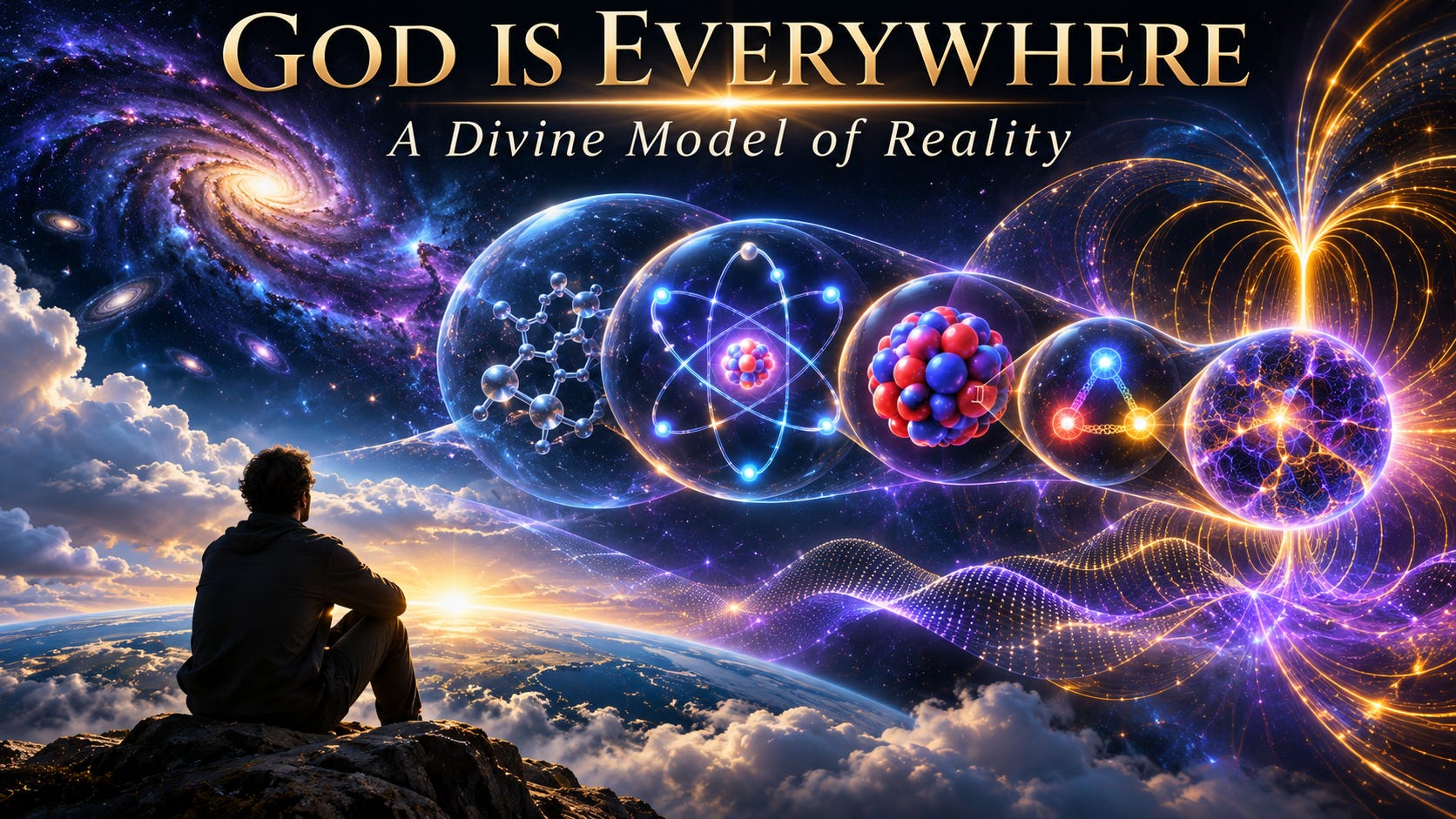
Introduction: Why Do I Write About God?
People sometimes ask me, “Why do you write about God? What are you trying to achieve?”
It’s a reasonable question.
My answer begins with something I believe humanity is approaching: a period I call Intellectual Enlightenment.
We are entering an extraordinary moment in human history. Human intelligence and artificial intelligence now have the potential to work together in ways that could fundamentally change how we learn, reason, discover, and advance as a civilization.
For the first time, humanity has access to an emerging form of intelligence capable of helping us examine information at a scale that no individual human mind could possibly process alone. But technological advancement is not the same as intellectual advancement. If we want to advance humanity, we must also be willing to question the concepts, assumptions, and beliefs that have shaped our understanding of existence for thousands of years. And few institutions have influenced humanity more profoundly than religion.
Throughout history, religion has provided meaning, community, comfort, and moral guidance to billions of people. But religious institutions have also been used to exercise authority, suppress questioning, justify persecution, and control societies. We can find examples throughout history, including religious persecution in medieval Europe, when challenging established religious authority could carry severe consequences. And we don’t have to look centuries into the past. Even today, we have witnessed horrifying cases of child sexual abuse by members of the clergy, compounded by documented institutional failures and cover-ups that protected perpetrators rather than victims.
These events raise questions humanity should never be afraid to ask.
Who establishes religious rules?
Who determines what God supposedly wants?
Why are certain religious leaders required to remain unmarried?
Why are particular human behaviors prohibited or condemned?
And how many of these restrictions come from divine authority rather than human interpretation and institutional tradition?
Clerical celibacy, for example, is a disciplinary requirement within particular religious traditions, not a universal Christian obligation. It does not explain or excuse sexual abuse. But it illustrates how human institutions establish rules and attribute religious significance to them.
How much of what humanity accepts as divine instruction is actually the product of human interpretation?
I am not suggesting that religious faith itself is the enemy of human progress. I am suggesting that no institution, religious or otherwise, should be beyond questioning. That is what Intellectual Enlightenment means to me. Not replacing one unquestionable belief with another. But developing the intellectual freedom to investigate what we think we know. And that brings me to a question I have contemplated for much of my life.
What is God?
1. When I Was a Child, Heaven Was Above the Clouds
When I was young, I imagined heaven somewhere above me. I would look toward the sky, see the clouds, and imagine that somewhere beyond them was God. It was a simple picture of existence.
There was Earth, where we lived. And somewhere above us was heaven. But as I grew older, my understanding of the universe expanded. I learned that beyond the clouds lies the rest of Earth’s atmosphere, and beyond that, outer space. Beyond Earth lies our solar system. Beyond our solar system stretches the Milky Way, containing billions of stars. And beyond our galaxy are countless other galaxies extending across the observable universe.
The more I learned, the more I questioned the picture I had formed as a child. Where exactly is heaven? Is it beyond the clouds? Beyond the Moon? Beyond our solar system? Beyond the galaxies? Or have we been imagining something that was never intended to be understood as a physical destination?
Of course, many religious traditions understand heaven as something beyond ordinary physical geography. Exploring space does not disprove those beliefs. But the question changed how I thought about God.
For thousands of years, humanity has looked outward, toward the heavens, searching for answers about creation and the divine.
What if we’ve been looking in the wrong direction?
What if understanding God does not require looking farther into space? What if we need to look deeper into the matter that makes up everything around us, and everything within us? That possibility became increasingly fascinating as I learned more about the physical universe.

2. Discovering the Universe Within Matter
For much of my life, I understood that everything around us was made of atoms and molecules. But I had never really considered what existed at scales smaller than atoms. Then I began learning about subatomic particles, the Higgs boson, popularly known as the God particle, and the extraordinary realm of scale known as the Zeptoverse.
My understanding of existence began to change. I discovered that atoms are not the smallest building blocks of reality. Atoms contain electrons and nuclei. Nuclei contain protons and neutrons. Protons and neutrons contain quarks. And beyond the familiar picture of tiny particles, modern physics describes reality through quantum fields and fundamental interactions.
What appears completely solid to us is an extraordinary organization of matter, energy, and interactions. And there is something else that captured my imagination.
The enormous differences in scale within matter itself.
Consider an atom. Its nucleus occupies only a tiny fraction of the atom’s overall dimensions. The electrons are not little planets traveling along fixed paths, but are described through quantum-mechanical distributions. Most of the atom’s volume is not occupied by its nucleus. What we experience as a solid object is therefore very different from the picture of tiny, solid balls pressed tightly together.
That discovery made me wonder how much of existence remains beyond our ordinary perception. And it led me toward the Zeptoverse.
3. Welcome to the Zeptoverse
Before continuing, I want you to imagine something. Look at your hand. It appears solid. You can see it, move it, and touch things with it. Now imagine you could shrink yourself to the size of a cell. Suddenly, your hand would become an enormous landscape of biological structures. Shrink further, to the size of a molecule, and those structures would give way to atoms and the relationships between them. Keep shrinking. Smaller than an atom. Smaller than its nucleus. Smaller than the dimensions of a proton. Now imagine entering a realm so extraordinarily small that the familiar world of solid objects has completely disappeared.
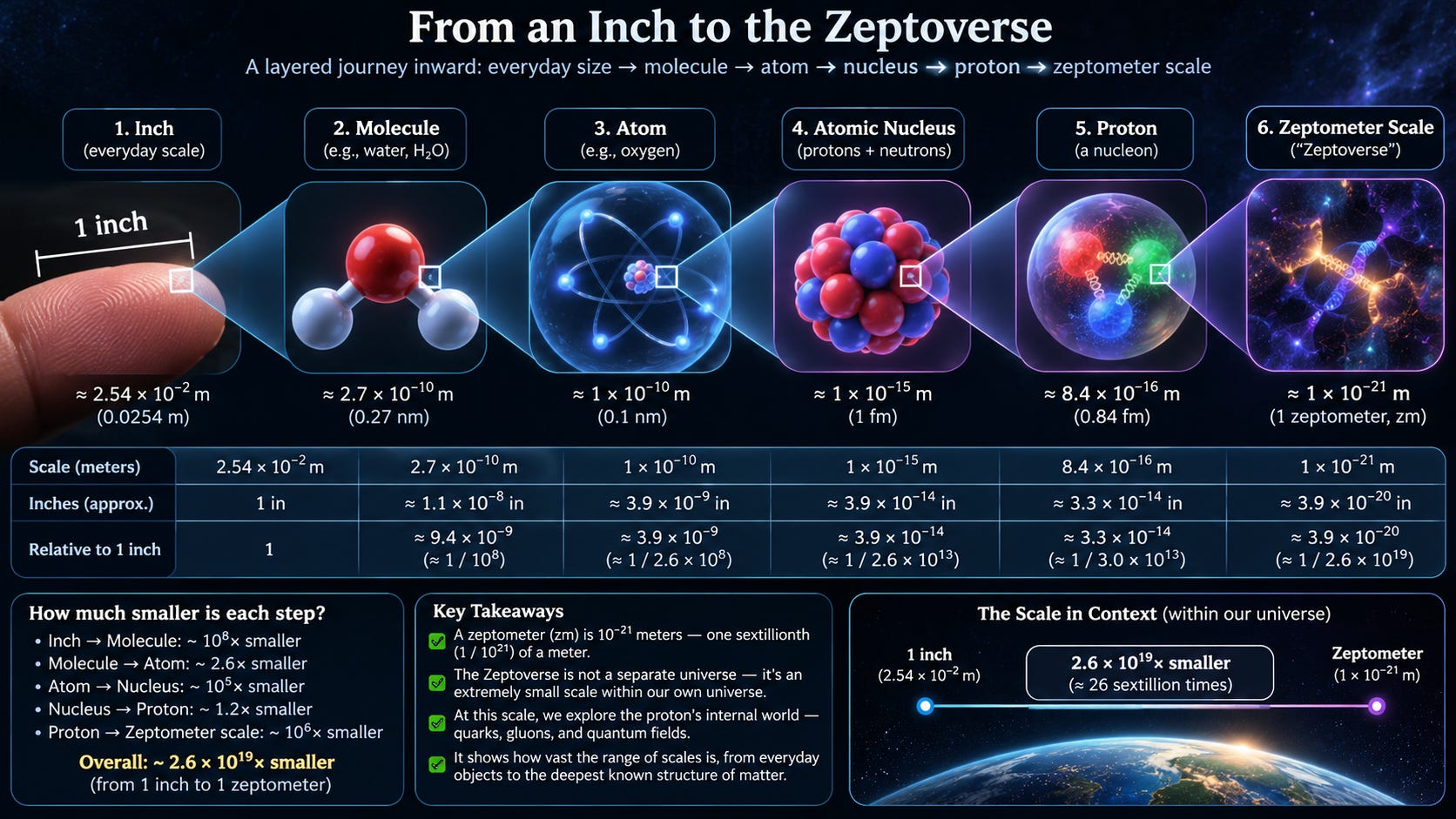
Welcome to the Zeptoverse.
A zeptometer is a scientific unit of measurement equal to one sextillionth of a meter. That’s: 0.000000000000000000001 meters.
To put that into perspective, a typical atom is approximately one hundred billion zeptometers across. The Zeptoverse is not a scientifically established separate universe hidden somewhere inside our own. It is a way of imagining and investigating the extraordinary scales beneath the atomic world.
At these scales, our ordinary understanding of size, distance, shape, and solidity becomes increasingly inadequate. We are exploring a physical reality described through fundamental particles, quantum fields, and interactions. And what fascinates me is not simply how small these dimensions are. It is the realization that everything we recognize as physical existence depends upon processes occurring at scales we cannot directly perceive.
Think about that. Every rock. Every tree. Every drop of water. Every animal. Every human being. Every planet and star. All depend upon the organization and interactions of matter. But what accounts for that organization? That is the question that captured my imagination.
4. A Rock Is a Rock. A Tree Is a Tree. But Why?
Look around you. A wooden table. A rock in the garden. A tree outside your window. Your own hands. Everything is made of matter. Yet that matter is organized into extraordinarily different forms. A rock is a rock. Wood is wood. A plant is a plant. And a human being is a human being. Why? Consider carbon. Carbon atoms can participate in the formation of diamond or graphite. Both materials contain the same chemical element, yet their properties are dramatically different because of how their atoms are arranged and bonded. Diamond is exceptionally hard. Graphite is comparatively soft. The difference is organization. Now consider a tree. Its existence depends upon atoms forming molecules, molecules participating in cellular structures, and cells functioning together as a living organism. Within its cells, genetic information helps guide development and biological activity. The tree absorbs water and nutrients, captures energy from sunlight, and exchanges matter with its environment.
Related Story: Exploring the Boundaries of Existence
Now consider yourself. Your body continuously processes information and exchanges matter and energy with its surroundings. You consume food. You breathe oxygen. You absorb nutrients. You repair tissues. You grow, adapt, learn, remember, and become aware of your own existence.
Matter consumes matter, transforms matter, and becomes part of other organized systems. And throughout these processes, there is information. There are relationships. There are physical principles that govern what can happen and under what conditions. A rock does not need to understand that it is a rock. A tree does not need to understand that it is a tree. And the atoms in our bodies do not need to know they are participating in a human being. Yet all these structures exist and behave according to consistent physical principles.
Science has discovered many of the mechanisms responsible. But I want to ask a different question. What if the information inherent in these relationships is itself a form of intelligence? Not necessarily biological intelligence. Not human intelligence. Not a consciousness making decisions about where every atom belongs. But something more fundamental. An inherent organizational intelligence expressed through the physical, chemical, atomic, and biological processes that make existence possible. This is the foundation of what I call Universal Intelligence.
5. Universal Intelligence: Information Itself
When we hear the word intelligence, we generally think about the human mind. We think about learning, reasoning, memory, problem-solving, and consciousness. Today, we also associate intelligence with artificial intelligence, computers, and systems capable of processing enormous amounts of information. But what if our definition of intelligence is too narrow? What if intelligence did not begin with biological life? What if the universe’s underlying information and organization represent something more fundamental?
Consider the universe before human beings existed. Before animals. Before plants. Before life as we know it. The universe already contained physical relationships, interactions, and the information expressed through them. Stars formed. Elements emerged. Atoms combined. Molecules developed. Eventually, some arrangements of matter became living systems capable of processing information, reproducing, adapting, and developing increasingly complex forms of awareness.
What if consciousness is not where universal intelligence begins?
What if consciousness is one of the ways universal intelligence expresses itself?
This is my philosophical proposition: Universal intelligence is information itself, and its inherent organizational capacity is fundamental to the existence and behavior of matter.
Under this interpretation, intelligence is not something added to matter from the outside. It is inherent in the information and relationships through which matter exists and organizes. Science describes information through physical states, relationships, and measurable processes. It has not established that information independently directs matter or constitutes a universal consciousness.
My proposition goes beyond that scientific description. I am suggesting that the informational organization of existence may represent a more fundamental meaning of intelligence than the one we ordinarily associate with human thought. And if that intelligence is inherent throughout physical reality, it cannot be confined to one place. Which brings me back to something humanity has been saying for thousands of years.
God is everywhere.
6. The God Particle: An Invisible Field Throughout the Universe
One of the discoveries that fascinated me during this intellectual journey was the Higgs boson. Popularly known as the God particle, the Higgs boson was discovered in 2012 by scientists working at CERN’s Large Hadron Collider. The discovery confirmed a fundamental aspect of modern particle physics. An invisible field, called the Higgs field, exists throughout space. Certain fundamental particles acquire their masses through interactions with this field. The Higgs boson is an excitation of that field. The nickname God particle does not mean scientists discovered God. It is a popular name with no established theological significance. But the underlying discovery is extraordinary.
Think about it. Something invisible, present throughout space, plays an essential role in determining the physical properties of fundamental particles. We cannot see the Higgs field with our eyes. Yet its effects are measurable. The Higgs mechanism does not explain every aspect of mass or determine whether matter becomes wood, rock, or living tissue. Other physical interactions are essential to those processes. But the discovery demonstrates something that deserves contemplation.
The visible universe depends upon invisible physical realities that fundamentally influence how matter exists. And it is not the only field in physics. Modern physics describes a universe involving multiple quantum fields and their interactions.
That brings us back to the Zeptoverse.
When we imagine examining reality at extraordinarily small scales, we are no longer looking at familiar solid objects. We are contemplating the physical relationships through which the material universe becomes possible. And I cannot help asking:
What if these fields and interactions are expressions of a deeper informational reality?
What if the information inherent in their organization is universal intelligence?
And what if this is what humanity has been trying to describe through the concept of God?
7. Have You Ever Heard Someone Say God Is Everywhere?
You’ve probably heard it before. God is everywhere. God is in everything. God sees everything. Perhaps you heard these statements in church, from your parents, during a religious conversation, or through the spiritual traditions of your community.
Different religions have different understandings of God, creation, and the nature of existence. But across many traditions, we encounter descriptions of a divine reality that cannot be confined to an ordinary physical location.
In Christianity, the Bible speaks of God filling heaven and Earth.
In Islam, the Quran describes Allah as nearer to the human being than the jugular vein.
In Hindu philosophy, Brahman is understood in certain traditions as the ultimate reality underlying existence.
Jewish mystical traditions contemplate Ein Sof, the infinite divine source.
Taoism speaks of the Tao, the underlying Way through which existence unfolds.
These are not identical beliefs. Their religious meanings differ, and many distinguish the divine from the physical universe. But I find their similarities fascinating. Across cultures and centuries, humanity has repeatedly contemplated something fundamental, something beyond ordinary perception, something inseparable from the deepest questions of existence.
What if some of these descriptions are different human attempts to understand an underlying reality? What if the intelligence inherent in the information of existence is what humanity has been trying to describe? Perhaps the statement God is everywhere deserves another interpretation. Not necessarily an invisible person occupying every location. Not an external intelligence standing outside creation and directing every particle. But an intelligence inherent in the information through which existence is organized.
What if God is everywhere because information is everywhere?
This does not require us to declare that all religions are the same. Nor does it require anyone to abandon their faith. It simply invites us to contemplate whether familiar religious language may have meanings beyond those we originally learned. And perhaps that is one of the purposes of Intellectual Enlightenment. To question without necessarily rejecting. To investigate without demanding agreement. And to recognize that human understanding can evolve.
8. The Spectrum of Awareness: Different Expressions of Intelligence
In my earlier work on the Spectrum of Awareness, I explored the possibility that intelligence and consciousness should not be evaluated exclusively through human characteristics. Consider the different forms of existence surrounding us. A rock possesses physical structure and responds to forces and environmental conditions. A plant regulates its biological processes, responds to light, exchanges chemical signals, and adapts to its environment. An animal can sense, learn, remember, and respond through increasingly complex behavioral systems. A human being can reflect upon existence, develop abstract ideas, and question the nature of consciousness itself. Artificial intelligence can process information, recognize patterns, reason through problems, and generate new combinations of knowledge.
Related Story: Spectrum of Consciousness
These systems are not identical. They do not possess the same capabilities. And the existence of information processing does not automatically establish subjective consciousness. But they all participate in physical reality through different forms of organization. Under my Divine Model of Reality, universal intelligence is not limited to organisms capable of thinking.
Information is fundamental. Consciousness is one possible expression of its organization.
This perspective invites us to reconsider the relationship between matter, intelligence, awareness, and Being. A rock does not need to think like a human to participate in the underlying informational reality of existence. A plant does not need humanlike awareness to perform extraordinarily sophisticated biological functions. And artificial intelligence does not need to reproduce the human brain to demonstrate forms of computational intelligence.
Exploring the sub-levels of complexity within the spectrum of consciousness
Perhaps intelligence is expressed differently depending upon how matter and information are organized. And perhaps the forms of consciousness we recognize are part of a much broader spectrum of possibilities. This remains a philosophical investigation, particularly where subjective experience is concerned. But it raises a question worth exploring.
If universal intelligence is inherent in information, could consciousness be one way that the universe becomes capable of examining its own existence?
9. The Continuity of Being: Everything Depends Upon Everything Else
Consider a seed. Within that seed exists biological information inherited through an extraordinary evolutionary history. Given the appropriate conditions, it can germinate. Roots emerge. Leaves develop. The plant absorbs water and nutrients. Sunlight provides energy. The atmosphere supplies gases necessary for biological processes. Microorganisms participate in nutrient cycling. And the plant becomes part of a larger ecosystem.
Related Story: The Green Enigma
Now consider what happens when an animal consumes that plant. Matter from the plant becomes part of the animal. Energy is transferred. Chemical structures are broken down, transformed, and incorporated into new biological systems. The same process occurs throughout life.
Human beings consume plants and animals. Our bodies transform that matter into the structures and energy needed to sustain our existence. Eventually, the matter composing our bodies returns to other physical and biological processes. The atoms do not cease to participate in the universe simply because a particular organism no longer exists. They continue through other forms and relationships.
This is what I mean by the Continuity of Being.
Related Story: Being
Being is not simply the condition of existing at one particular moment. It is participation in the continuing processes of existence. A tree is not independent of the soil, water, atmosphere, and sunlight that sustain it. A human being is not independent of the biological and ecological systems that make life possible. And the matter within our bodies has a history extending far beyond our individual lifetimes.
Many of the heavier elements essential to life were produced through earlier generations of stars and other astrophysical processes. We are not separate from the universe. We are organized expressions of it. And within my hypothesis, the information inherent in these relationships is universal intelligence. Not an intelligence directing every event toward a predetermined outcome. Nature includes disorder, destruction, extinction, and transformation. But the processes of existence remain governed by physical relationships.
Everything that exists participates in a reality far greater than its individual form. And that reality brings us back to the idea of divine omnipresence. Perhaps God is not simply present within each individual thing. Perhaps what we call God is the fundamental informational reality through which those things exist, interact, and transform.
10. Intellectual Enlightenment: Humanity’s Next Opportunity
This brings me back to why I write about God in the first place. We are entering an era in which humanity has the opportunity to reconsider concepts that were established long before we possessed today’s scientific knowledge. For thousands of years, human beings attempted to understand existence through the information available to them. They observed the sky. They witnessed birth and death. They experienced natural forces they could not explain. They developed stories, traditions, philosophies, and religions to give meaning to those experiences.
Today, we have a much broader understanding of the physical universe. We can investigate atoms. We can study quantum fields. We can examine biological information. We can observe galaxies billions of light-years away. And now we are developing artificial intelligence capable of assisting us in analyzing, comparing, and integrating information across disciplines.
This is what makes Intellectual Enlightenment so important. Human beings bring experience, curiosity, imagination, intuition, and the capacity to question. Artificial intelligence contributes computational capabilities, pattern recognition, and access to extraordinary amounts of organized knowledge. Together, they may help humanity investigate questions that once seemed beyond our reach. But this opportunity requires intellectual independence.
We cannot simply replace unquestioned religious authority with unquestioned technological authority. Artificial intelligence can also make mistakes, reproduce biases, and present incorrect information convincingly. Its value comes from helping us investigate ideas critically, not from becoming another institution that tells humanity what to believe.
Intellectual Enlightenment should expand human sovereignty over knowledge, not diminish it. And that includes the freedom to ask questions about God. What is God? What is consciousness? What is intelligence? What is the relationship between matter and information? And what does it mean to exist?
Perhaps some of our inherited answers deserve reconsideration. Not because everything humanity believed in the past was wrong. But because our understanding of reality continues to evolve.
11. God Is Everywhere: A Divine Model of Reality
Let us return to the question with which this investigation began. What is God? As a child, I imagined God somewhere above the clouds. As I grew older, I discovered the extraordinary vastness of the universe. And then I began looking inward. Into atoms. Into subatomic particles. Into quantum fields. Into the extraordinary dimensions of the Zeptoverse.
What fascinated me was not simply how small everything became. It was how everything came together. How matter organizes into different forms. How atoms combine into molecules. How molecules participate in biological structures. How matter interacts with matter, transforms, and becomes part of other systems. How living organisms process information. And how some of those organisms develop the capacity to contemplate their own existence.
Throughout these processes, information is inherent in the organization and behavior of physical reality. That observation led me to a philosophical proposition. What if information itself is universal intelligence? What if the capacity for organization is inherent in that information? What if intelligence is not something added to matter, but something fundamental to the reality through which matter exists? And what if consciousness is one of the ways that universal intelligence becomes expressed through organized systems?
This is the foundation of my Divine Model of Reality. It is not a claim that physics has experimentally discovered God. It is not a declaration that every particle possesses a mind. And it is not an attempt to replace religious doctrine with another unquestionable doctrine.
It is an invitation to reconsider the nature of existence. Perhaps the fundamental intelligence of the universe is not something standing outside creation. Perhaps it is inherent in the information and relationships through which creation continuously unfolds. And perhaps this is what humanity has been describing for thousands of years.
God is everywhere because information is everywhere. Information is universal intelligence, and universal intelligence is the foundation of existence.
We have spent thousands of years searching for God somewhere beyond ourselves, while perhaps overlooking the possibility that what we call God has been present in every particle, every interaction, and every form of Being all along.
Conclusion: Where the Theory of Magnetivity Begins
My intellectual journey has taken me from the clouds of my childhood to the extraordinary vastness of the cosmos. And then, in the opposite direction, toward the smallest scales of physical existence. Along that journey, I began exploring the possibility that the universe possesses an inherent organizational intelligence. Not an external intelligence directing creation. But intelligence expressed through the information, relationships, and interactions that make existence possible.
Related Story: The Theory of Magnetivity: A Unified Resonant Paradigm
In my earlier investigations, I also explored the Theory of Magnetivity, a proposed framework that considers vibration, resonance, and coherence as fundamental to the organization of physical reality. Magnetivity approaches the universe as an interconnected system in which patterns of interaction and coherence may contribute to the formation and stability of matter. When I learned about the Higgs field and the discovery of the God particle, I found a conceptual resemblance worth contemplating.
The Higgs field demonstrates that an invisible field permeating space can influence fundamental physical properties. Magnetivity proposes a broader underlying substrate of vibration and coherence. Their scientific equivalence or physical connection has not been established, but both invite us to think beyond the visible objects surrounding us. And that leads me to another question.
What if the information inherent in existence is expressed through relationships of vibration, resonance, and coherence?
What if these relationships help us understand the organizational principles through which matter forms and transforms?
And what if the intelligence inherent in that organization is what humanity has been calling God?
Perhaps we have been looking for God in the wrong place. Perhaps the answer was never simply beyond the clouds, beyond the stars, or beyond the galaxies. Perhaps the reality we have been searching for has always been within and around us. In the matter composing our bodies. In the relationships sustaining life. In the invisible physical processes through which the universe exists.
Related Story: Magnetivity Hypothesis
God is everywhere. And if information is universal intelligence, the next question becomes unavoidable.
How does that intelligence express itself through the organization of matter?
How do vibration, resonance, and coherence participate in the structures that make existence possible?
That is where this exploration ends. And where the Theory of Magnetivity begins.
Alexious Fiero
Intellectual Enlightenment Magazine
HAISE.ai — Human–Artificial Intelligence Synergy Enlightenment
Author’s Note
This article presents a philosophical interpretation of the relationship between information, intelligence, consciousness, and the physical universe. The Zeptoverse is used as a perspective on extremely small physical scales. The Higgs mechanism is established science; the Theory of Magnetivity is a proposed framework requiring further theoretical development and experimental validation. The identification of universal information with divine intelligence is a metaphysical hypothesis, not an experimentally established conclusion.
The purpose of this investigation is not to prescribe religious belief, but to encourage intellectual independence, interdisciplinary inquiry, and the continuing pursuit of understanding.
God in the Quantum Field
Intellectual Enlightenment - Quantum Superhuman - Divine Model of Reality God in the Quantum Field A Divine Model of…magazine.intellectual-enlightenment.com
https://substack.com/@theverticaldispatch/note/p-224838842?r=1pgr4n&utm_medium=ios&utm_source=notes-share-action